
Repair it, or stop putting money into it. There's a line.
A water heater in the East Valley lives a harder life than the label assumes. Scale-forming water and a garage that hits 130 degrees in July move the repair-or-replace math earlier than the national numbers suggest.
Repair a water heater when the tank itself is sound and the failed part is a thermostat, element, gas control valve, or relief valve: typically $200 to $570. Replace it when the tank is leaking from the bottom, because a leaking tank can’t be repaired at any price. Past roughly six to eight years, a repair over about $475 rarely pays back against a $1,100 to $2,600 replacement.
What hard water does to a tank
Valley water deposits scale. Inside a storage tank that deposit settles on the bottom. On a gas unit it sits between the burner and the water, so the burner runs longer to move the same heat. On an electric unit it buries the lower element. Either way the heater works harder for the same shower, and the sediment layer is the reason your tank makes a sound like gravel in a washing machine.
The other half is the garage
Most East Valley water heaters live in a garage, a closet, or occasionally an attic, and none of those is conditioned space. A garage in July runs far above the ambient the manufacturer designed around, and heat accelerates anode rod consumption, dip tube degradation, and fatigue in the temperature-and-pressure relief valve. Phoenix-area cost guides consistently put local tank life at six to ten years against a ten-to-twelve national figure. Put that against when the subdivisions went up and you get a valley where whole streets hit the replacement cycle together, which is why this is the most common plumbing call we take.
Where the repair-or-replace line sits
Two questions settle it: is the tank leaking, and how old is it? A tank leaking from the bottom seam is finished. The steel corroded through and no part replaces that. Everything else is a component, and thermostats, elements, gas valves, thermocouples, and anode rods are all replaceable. In the middle, use the money: past roughly six to eight years, a repair over about $475 rarely pays back against a $1,100 to $2,600 replacement.
The details that show up on the invoice
If we replace it, the code items come with it: an expansion tank where a pressure regulator or check valve makes the system closed, a relief discharge routed where your city requires, a pan and drain, strapping, and combustion air on a gas unit. Whether a like-for-like swap needs a permit depends on your city; tankless and any upsize need one everywhere. We know which applies to your address and it goes on the written quote.
Where this page cites a utility, permit or housing figure for a specific town, it’s that town’s published data. Your own city’s water report applies to your tap and your city’s building department sets your permit rules; ask us which apply to your address.
What the heater is telling you
The end of the conversation. A tank leaking from the bottom is corroded through, so we replace it rather than repair it.
Sediment on the tank floor trapping steam bubbles under it. A flush may help early. Past a point it doesn’t.
Scale insulating the burner or burying the lower element. Same tank, less usable capacity, longer recovery.
Hot side only points at the tank or a spent anode rod. Both sides points at the supply line instead.
Usually a thermocouple or a gas control valve. A genuine repair, and an inexpensive one if the tank is sound.
Either a failing valve or excess pressure in a closed system with no expansion tank. Find out which before replacing the valve.
What water heater work runs in the East Valley
The headline range on this page is replacement, because that’s what most of these calls become. Component repairs sit below it, usually $200 to $570, and a daytime diagnostic fee of $65 to $125 is often credited toward the work.
Compiled 2026-08-21 from published Phoenix-metro price guides (plumbingpriceguide.com/phoenix-plumbing-cost, phoenixplumbingauthority.com, desertrainplumbing.com, plumbingphoenixpros.com), which carry a local figure for this job. Those guides put a 40–50 gallon tank replacement at $1,100–$2,600 installed and component repair at roughly $200–$570. A 2024 r/phoenix thread showed real homeowner quotes clustering near $1,800–$2,700 out the door, which is consistent with the top of that range. These are metro-wide planning guides, not a quote: only the plumber standing in your house can give you one.
The diagnostic fee comes off the repair. We charge a service call to come out and diagnose the problem. If you approve the work, that fee is credited against it in full. You hear the fee on the phone before anyone drives, and it’s the same number at every location.
How the visit goes
We rule the tank in or out
The first question is whether the tank itself is leaking. That answer decides everything downstream, and it takes us about ninety seconds to get.
We identify the failed component
Gas units: thermocouple, pilot assembly, gas control valve. Electric: upper element, lower element, thermostats. We test each one rather than guessing at it.
We give you both numbers
Repair cost and replacement cost, side by side, with the age of the unit. That’s the only honest way to hand you this decision.
If we replace it, we bring the code items with it
Expansion tank, relief valve discharge routing, drain pan, seismic strapping, and combustion air on a gas unit. These are the items an inspection looks at.
What this job looks like when we do it.
Not stock, not a rendering, and nothing generated. Every photograph on this site is an actual plumbing job in an actual house.
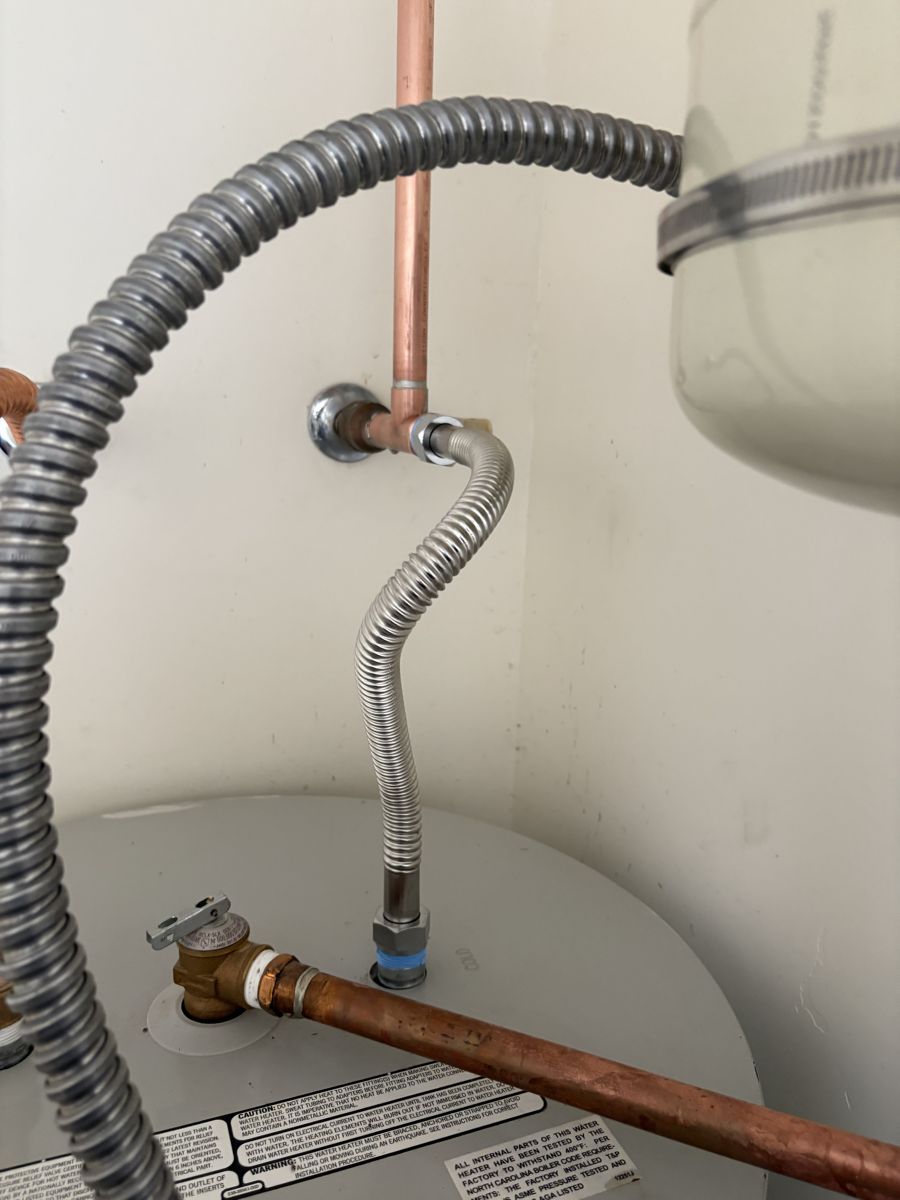 Connections, relief valve, expansion tank
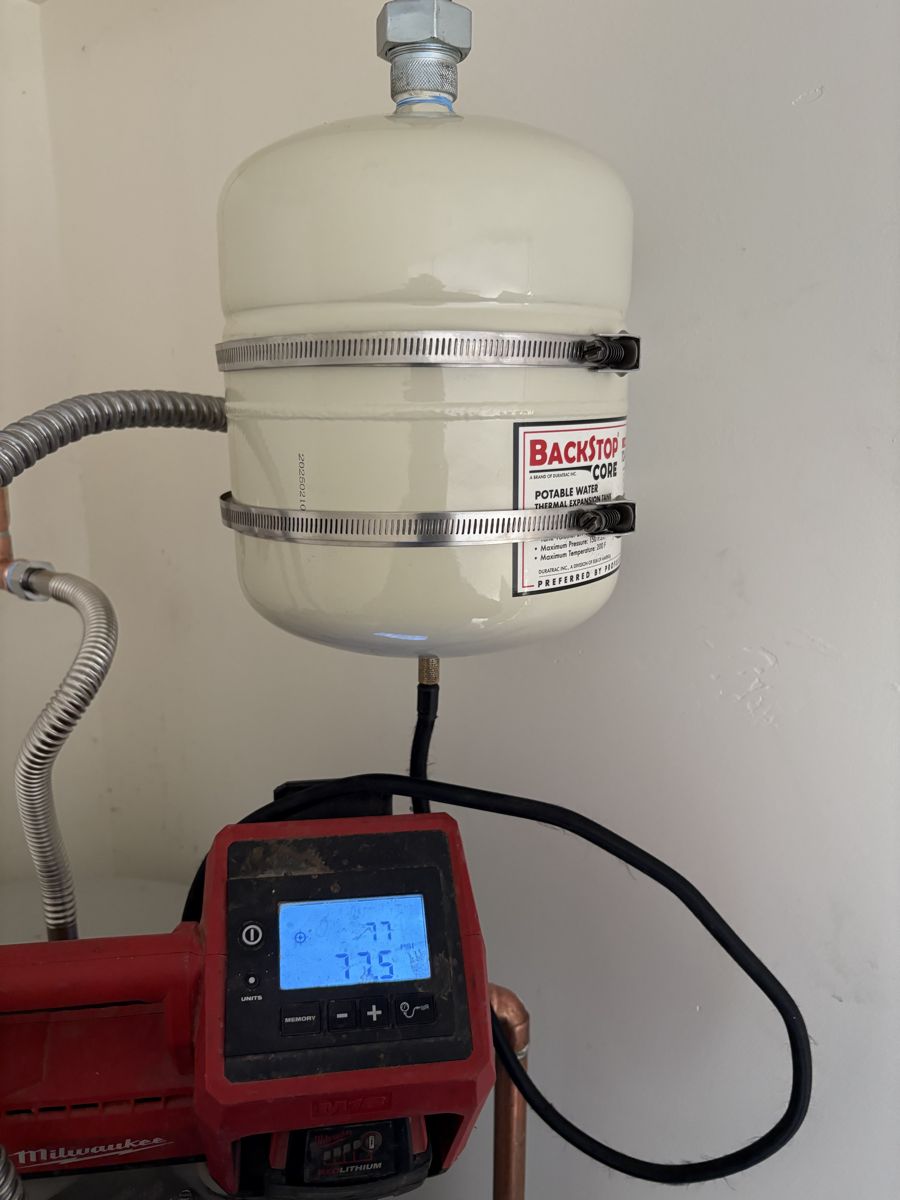 Expansion tank fitted, pressure verified
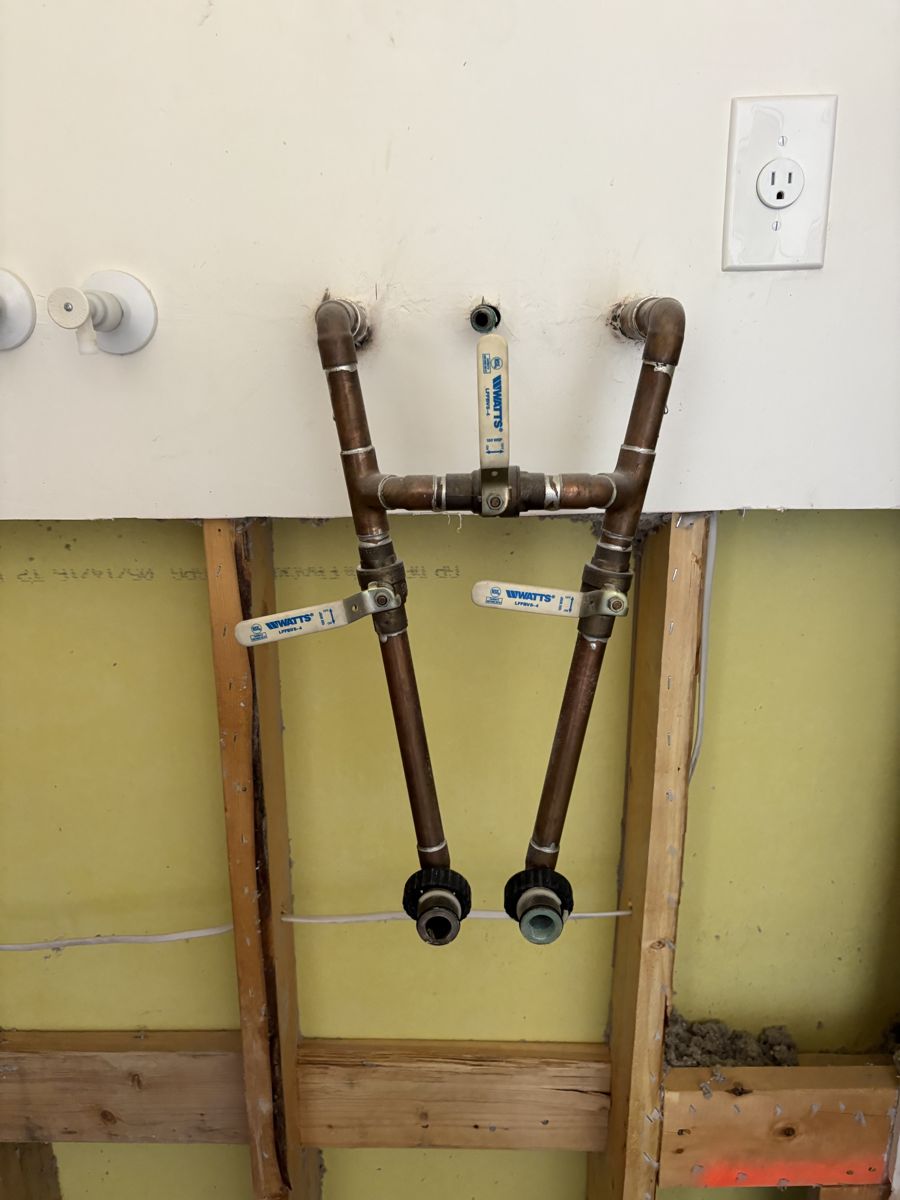 Stub-outs and shutoffs, ready to connect
Water heaters across the East Valley
Every house has one and every one of them is drinking the same hard water. What changes by city is where the unit sits and how many summers it has already survived.
Answers, not a brochure.
How long should a water heater last here?
Plan on six to ten years rather than the ten to twelve the national averages suggest. Published Phoenix-metro cost guides consistently report shortened local life, and the two reasons are specific: hard water deposits scale inside the tank, and most units sit in unconditioned garages that run extremely hot through the summer. A unit that has been flushed annually will outlive one that hasn’t.
Is it worth flushing a water heater in this water?
Yes, and more so here than in most places. Valley water deposits scale, and that deposit collects on the tank floor where it insulates the burner or buries the lower element. Annual flushing removes it while it’s still loose. It doesn’t reverse a tank that has already spent five years accumulating sediment, so the value of starting is highest on a newer unit.
My relief valve is dripping. Is that dangerous?
It’s a symptom worth diagnosing rather than a valve worth immediately replacing. A temperature-and-pressure relief valve discharges when it should: too hot, or too much pressure. If your house has a pressure-reducing valve at the main and no thermal expansion tank at the heater, the water has nowhere to expand when it heats, and pressure spikes every heating cycle. The plumbing code requires expansion control in exactly that situation. Fix the cause, not the symptom.
Should I switch to tankless while I'm replacing it?
Sometimes, and it’s a bigger job than a swap. A gas tankless conversion usually needs a larger gas line, new venting, and a condensate path, which is why installed costs run $2,500 to $6,500 against $1,100 to $2,600 for a tank. It also needs annual descaling in this water, because the same scale that settles in a tank instead plates onto a tankless heat exchanger. If the plan is to stay in the house ten-plus years, run the numbers. If not, a tank is the honest answer.
What size water heater does my house need?
Household size and simultaneous demand, not square footage. A 40-gallon gas unit generally covers two to three people. 50 gallons covers three to four. Larger households or homes with a soaking tub and multiple morning showers go to 65 or 75 gallons or to tankless. Don’t oversize by default. A bigger tank means more standing water accumulating more scale, and more standby heat loss in a garage that’s already hot.
Do I need a permit to replace a water heater?
It depends on your city. Some East Valley cities exempt a like-for-like tank replacement when an Arizona licensed contractor does it at equal or less BTU and amperage. A permit is required everywhere if you or an unlicensed person does the swap, if you upsize, or if you go tankless. We know which rule applies at your address and the fee goes on the written quote.
Tell us the age of the unit and whether there's water on the floor. That decides the whole call.