
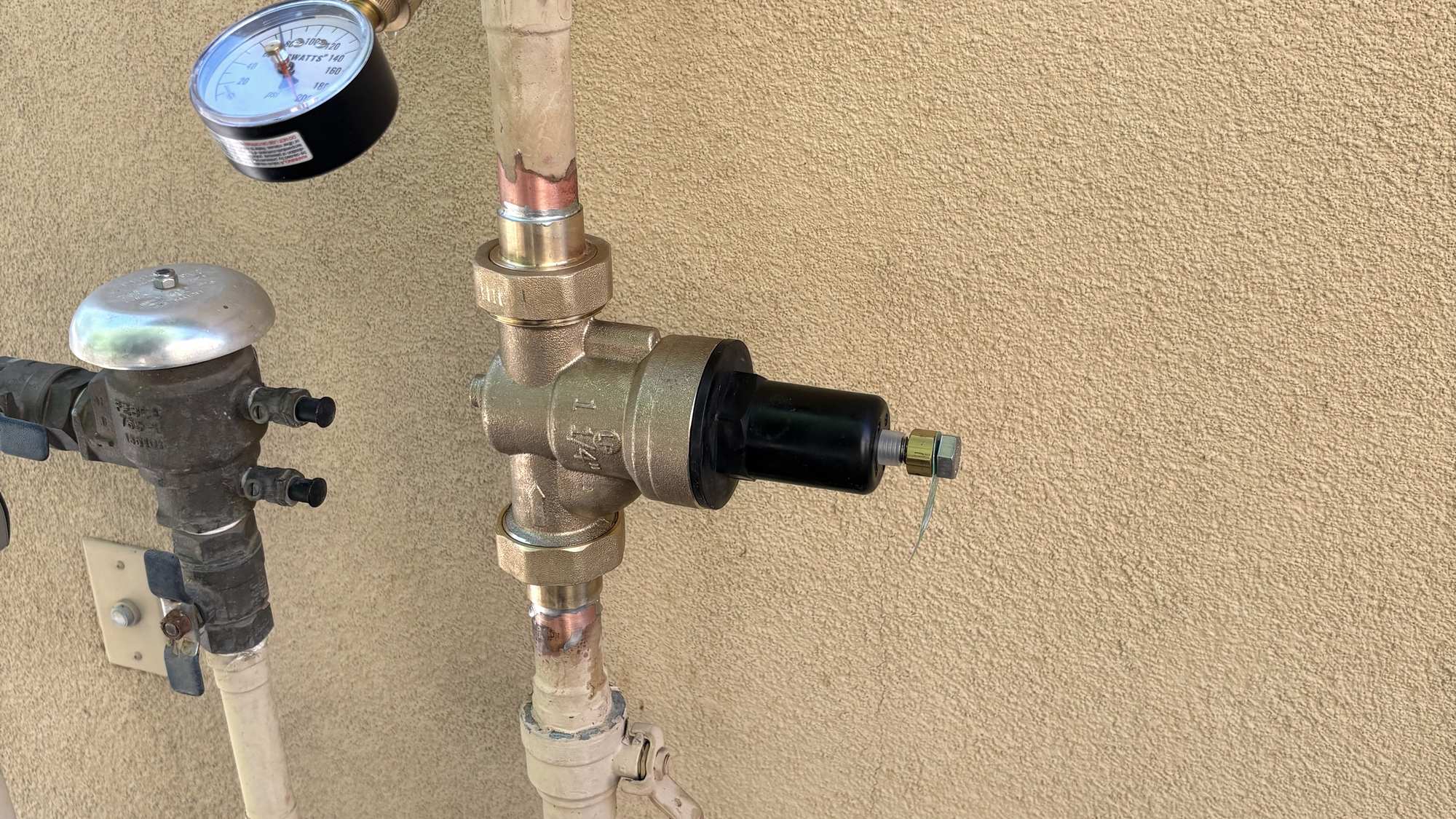
Twelve dollars of gauge answers this before anyone drives over.
A pressure-reducing valve is a mechanical part that eventually fails, usually open. When it does, everything downstream of it is held at whatever the street feels like, and the weakest fitting finds out first.
A pressure-reducing valve drops incoming street pressure to a safe level for household plumbing, and replacing one in the East Valley typically runs $250 to $600. The plumbing code requires a PRV wherever static pressure exceeds 80 psi. A $12 gauge on any hose bib tells you your number in about ten seconds.
Buy the gauge before you buy the diagnosis
A water pressure test gauge costs about twelve dollars and screws onto a hose bib. Turn everything off, thread it on, open the bib fully, and read it. That’s static pressure, and it’s the whole question on this page. Under 80 psi, your regulator is doing its job. Over 80, either the PRV has failed open or there was never one fitted. Take a reading early in the morning too, because municipal pressure is often highest overnight when demand is lowest.
Where 80 psi comes from
The International Plumbing Code requires a pressure-reducing valve where static pressure at the building supply exceeds 80 psi, and the Residential Code says the same. Now the part most plumbing sites get wrong: most East Valley utilities deliver at or below that threshold, so many homes don’t need a PRV on incoming pressure alone, and anyone telling you “high water pressure” is destroying your fixtures without a gauge reading is guessing. Homes at the high end of the delivery range sit right at the limit with no margin, which is the honest reason to measure rather than assume.
What high pressure actually costs you
Not a dramatic burst, usually: attrition. High static pressure accelerates wear on braided supply lines, toilet fill valves, faucet cartridges, washing machine inlet valves, and the water heater’s relief valve, and it raises water usage because every fixture flows harder than it needs to. People replace three supply lines and a fill valve in one year without connecting it to a house running at 95 psi. Put the gauge on before you replace the fourth thing.
The expansion tank consequence
Here’s the part that surprises people: installing a PRV creates a closed system. Water can no longer expand back toward the main when the heater warms it, so pressure climbs every heating cycle with nowhere to go. The plumbing code requires thermal expansion control where a storage water heater’s supply passes through a check valve, PRV, or backflow preventer. In practice that’s an expansion tank on the cold inlet. A tankless unit doesn’t trigger it. If we’re quoting a PRV and there’s no expansion tank at your tank heater, that item belongs in the same quote, and a relief valve that started dripping shortly after a PRV went in is this exact problem.
Where this page cites a utility, permit or housing figure for a specific town, it’s that town’s published data. Your own city’s water report applies to your tap and your city’s building department sets your permit rules; ask us which apply to your address.
What high pressure looks like before you measure it
Braided supply lines, fill valves, and cartridges wearing out repeatedly is attrition from pressure, not bad parts.
Water hammer is far more violent at high pressure. A washing machine or dishwasher shutting off is the usual trigger.
Either a closed system with no expansion tank, or excess supply pressure. Both trace back to this page.
A fill valve trying to seal against pressure it wasn’t designed for weeps, refills, and repeats.
A PRV failing open is gradual. People adapt to it before they notice it, which is why the gauge matters.
Every fixture flowing harder than necessary, every time anyone uses it, for a whole billing period.
What PRV work runs in the East Valley
A standard, accessible regulator at the main is a contained job. Cost climbs when the valve is buried in a cramped meter box, when copper has to be reworked, or when the missing expansion tank comes along with it.
Compiled 2026-08-21 from published Phoenix-metro price guides (plumbingpriceguide.com/phoenix-plumbing-cost, phoenixplumbingauthority.com, desertrainplumbing.com, plumbingphoenixpros.com), which carry a local figure for this job. Those guides put a residential PRV replacement at $250–$600 for the Phoenix metro. Individual Phoenix pages run $250–$600 with difficult cases to $800, and another lists $390–$750. The expansion tank figure of $145–$285 comes from a Phoenix cost page checked the same day. The adjustment-only row is a planning figure rather than a cited one. These are metro-wide planning guides, not a quote: only the plumber standing in your house can give you one.
The diagnostic fee comes off the repair. We charge a service call to come out and diagnose the problem. If you approve the work, that fee is credited against it in full. You hear the fee on the phone before anyone drives, and it’s the same number at every location.
How the visit goes
We measure static pressure
A gauge on a hose bib with the house at rest. If you’ve already taken the reading, say the number when you call and half the diagnosis is done.
We locate the regulator and assess it
Usually at or near the main shutoff, sometimes in the meter box. We decide right there whether it can be adjusted or has to be replaced.
We shut the water off and swap the valve
We shut the main, cut out the old regulator, fit the new one, then repressurize the house and check the new joints for leaks.
We set the pressure and deal with the closed system
We dial the new PRV well under the 80 psi ceiling and verify it at a fixture. If there’s no expansion tank at your water heater, we raise that now.
What this job looks like when we do it.
Not stock, not a rendering, and nothing generated. Every photograph on this site is an actual plumbing job in an actual house.
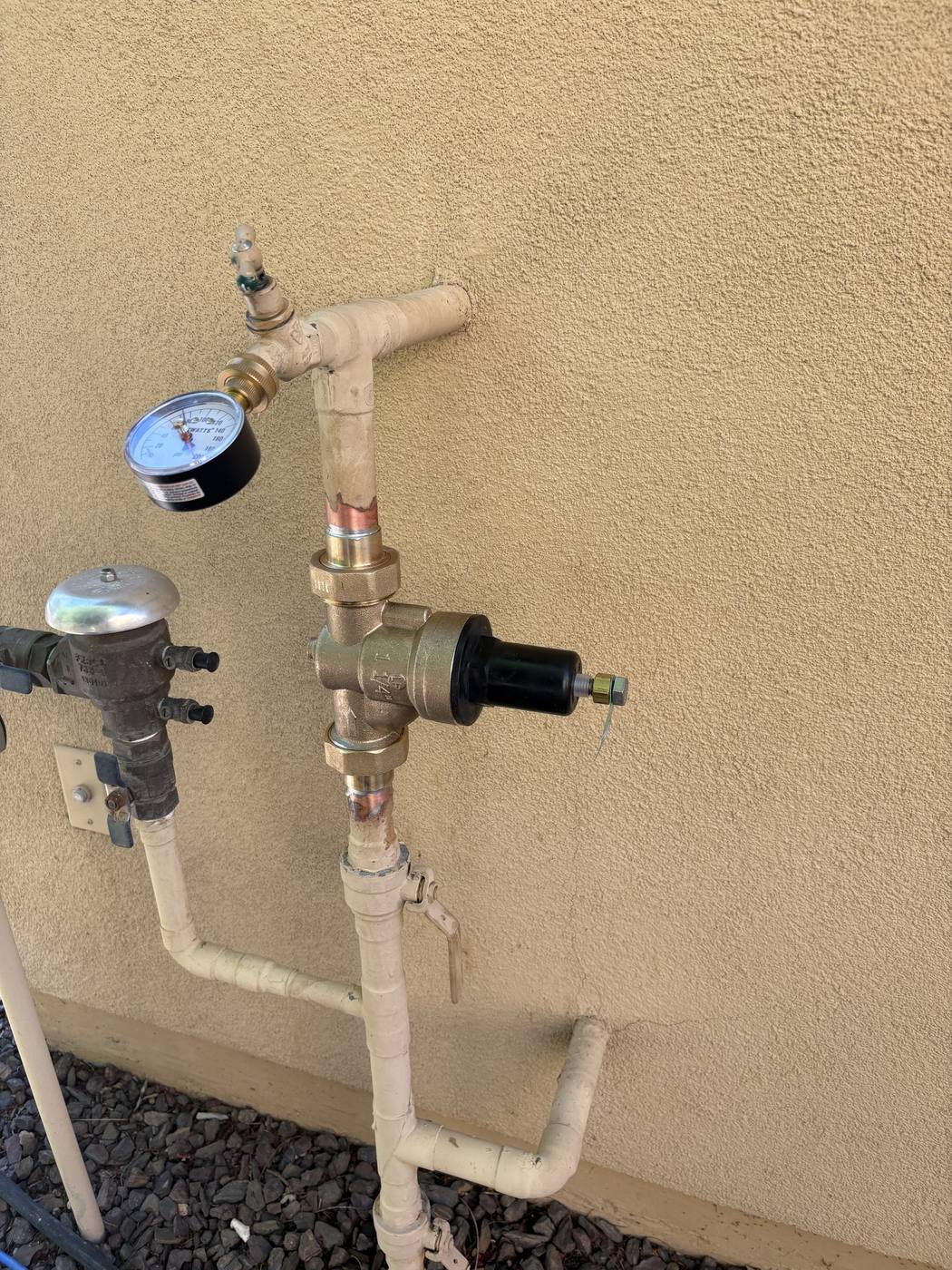 Pressure-reducing valve, exterior wall
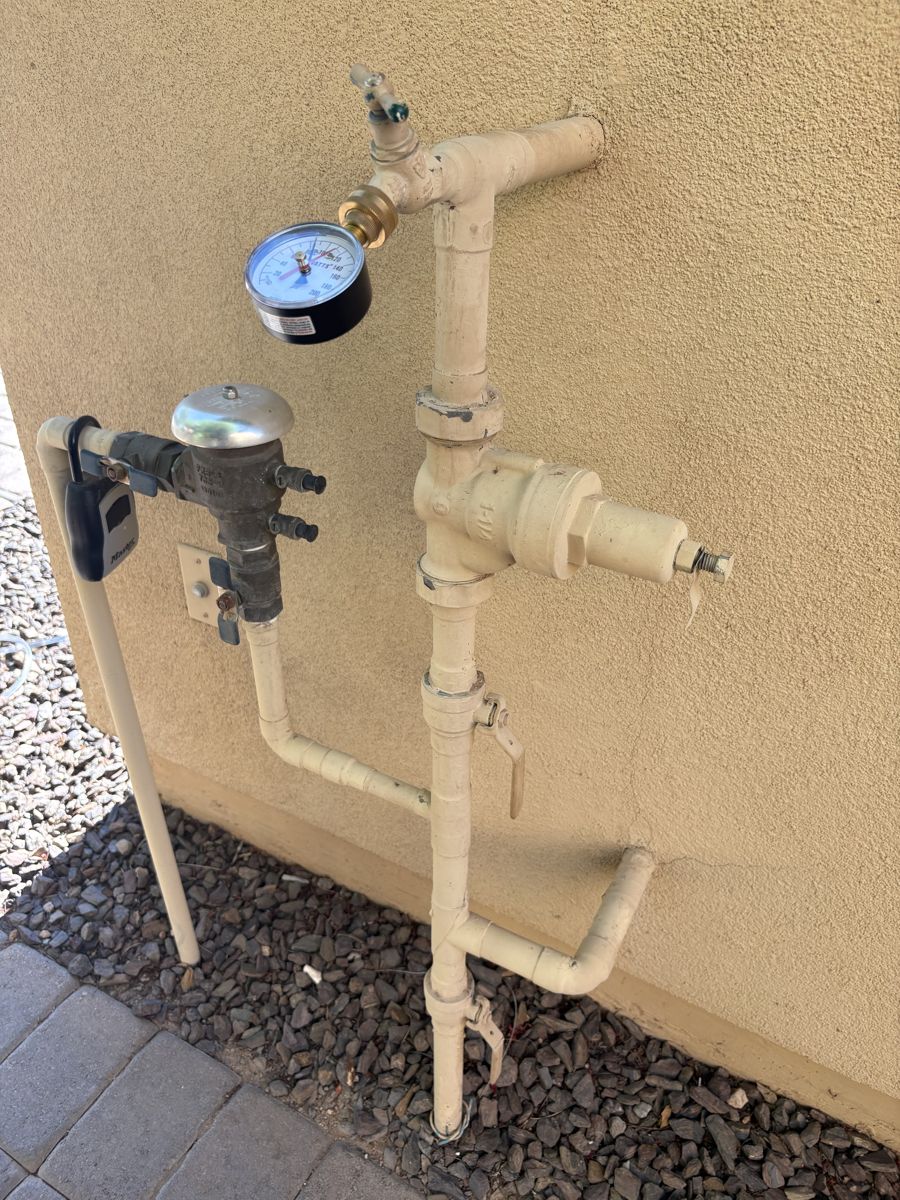 Regulator, backflow, and the gauge that settles it
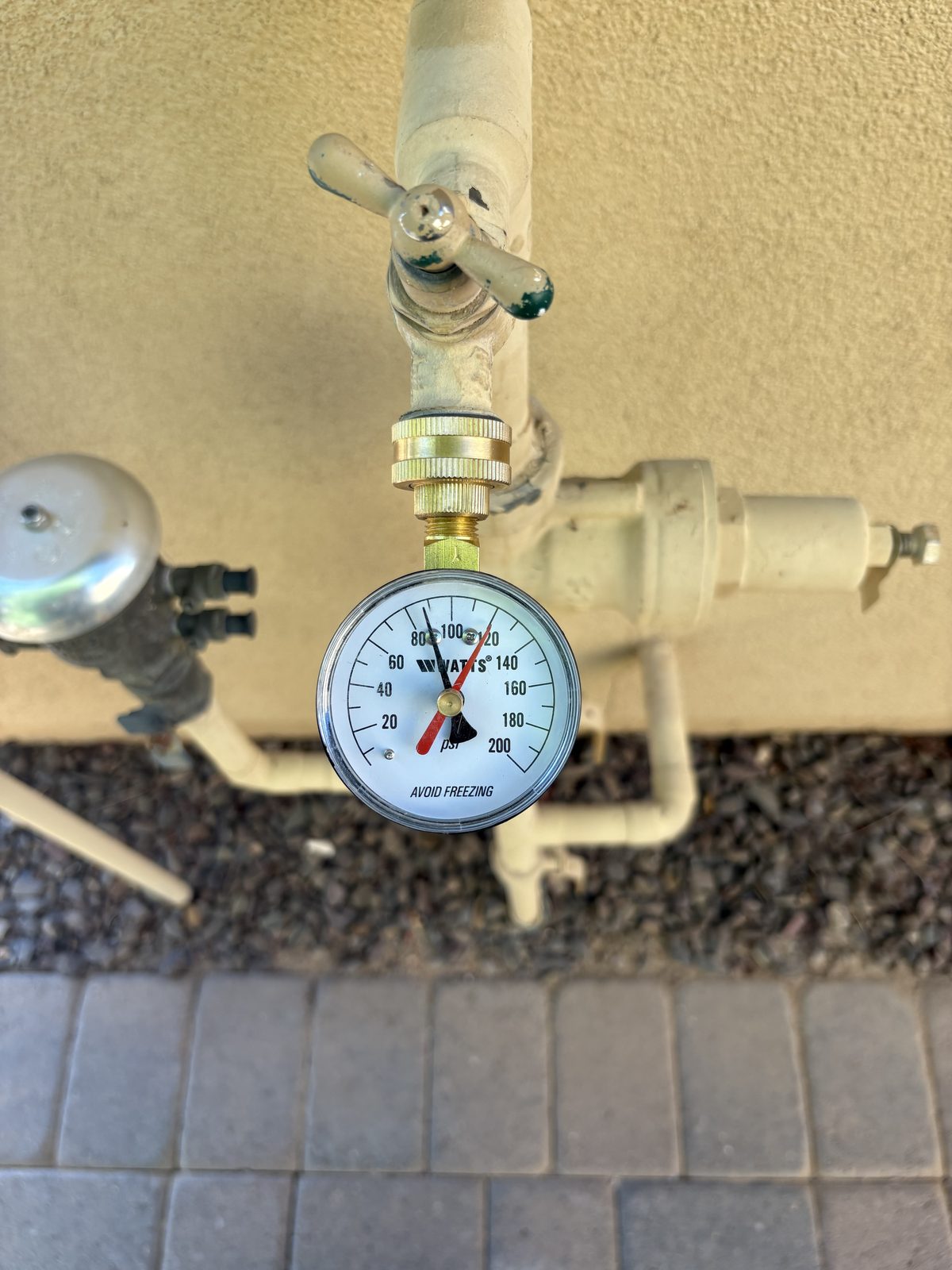 Above 80 psi: this house needs a regulator
Pressure across the East Valley
Elevation and distance from a pumping point vary the number street to street. Newer subdivisions were generally built with regulators. Older stock sometimes wasn’t.
Answers, not a brochure.
What water pressure should my house have?
Under 80 psi static, and comfortably so. The plumbing code requires a pressure-reducing valve wherever static pressure exceeds 80 psi. We set ours somewhere in the 50 to 70 range for household comfort and component life, which is where most of the trade lands. Most East Valley utilities deliver right up to that threshold, so the margin is thin by design.
How do I test my water pressure myself?
Buy a water pressure test gauge, roughly twelve dollars at any hardware store. Turn off every fixture and appliance in the house, thread the gauge onto a hose bib, open the bib fully, and read it. That’s your static pressure. Take a second reading early in the morning, because municipal pressure is often highest overnight when demand is lowest. A house that reads 75 psi at 3pm can be sitting well above 80 at 4am, and that’s when the damage accumulates.
How long does a pressure regulator last?
It’s a mechanical valve with a diaphragm and a spring, and it wears. Many last a decade or more. Some fail sooner, particularly if there’s sediment in the water working on the seat. The important thing is the failure mode: they usually fail open, meaning the house quietly starts running at street pressure, and nothing dramatic announces it. That’s the argument for putting a gauge on a hose bib once a year rather than waiting for a symptom.
Do I need an expansion tank if I install a PRV?
Almost certainly, and it belongs in the same quote. A PRV prevents water from flowing back toward the main, which makes your plumbing a closed system. When the water heater warms 50 gallons, that water expands and has nowhere to go, so pressure spikes every heating cycle. The plumbing code requires thermal expansion control in exactly this situation. The usual symptom of skipping it is a temperature-and-pressure relief valve that drips.
Can high water pressure damage my plumbing?
Mostly by attrition rather than by dramatic failure. Sustained high static pressure accelerates wear on braided supply lines under sinks, toilet fill valves, faucet cartridges, washing machine inlet valves, and the water heater's relief valve, and it makes water hammer significantly more violent. It also raises consumption, because every fixture flows harder than it needs to. If you’ve replaced several small components in a single year, measure the pressure before you replace another.
Where is the pressure regulator on my house?
Usually at or immediately after the main shutoff where the service line enters the property: often a bell-shaped brass fitting with an adjustment screw on top, sometimes inside the meter box, sometimes on an exterior wall near the front hose bib. Not every house has one. If your static pressure reads under 80 psi and you can’t find a regulator, that’s a legitimate configuration rather than a missing part.
Often the same visit.
Put a gauge on a hose bib and tell us the number. It's the whole conversation.