
First find the shutoff. Everything else can wait ten minutes.
A burst line is one of the few plumbing problems where what you do before the truck arrives changes the size of the bill. The valve is usually in the garage wall or at the meter box out front.
If a pipe has burst, shut the water off at the main first: usually on the garage wall near the water heater, or in the meter box at the curb. Then open the lowest faucet in the house to bleed the remaining pressure so the break stops discharging. Repair runs $350 to $1,500, depending on where the pipe is and what has to be opened to reach it.
The first five minutes
Shut the main. In a slab-on-grade house the interior shutoff is commonly on the garage wall near the water heater, or on an exterior wall where the service line enters. If you can’t find it or it won’t turn, the meter box at the curb has a valve on the house side. Once the water is off, open the lowest faucet in the house, a hose bib or a tub spout, to bleed the remaining pressure so the break stops discharging. Then photograph everything before you move a single towel, because your insurer will want the before.
Why a burst is almost never the city’s fault
East Valley utilities run well-maintained distribution systems, so when a house floods the failure is nearly always downstream of the meter, which puts it on the homeowner’s side of the property line and outside anything the city will repair. Knowing that in the first ten minutes stops you waiting for a municipal crew that was never coming.
What actually bursts here
Freezing isn’t the valley story. Ours are: hose bibs and exposed irrigation manifolds cooked by UV and heat and then split on a cold January night. Attic runs that have spent summers in an unconditioned space. Copper thinned from the inside over decades by scale-narrowed bore and the higher water velocity that comes with it. Pressure is the fourth, though be careful with that one. Most East Valley utilities deliver at or below the 80 psi the code sets as the ceiling, so the city isn’t usually over-pressuring your house. What does over-pressure a house is a pressure-reducing valve that has failed open, and when that happens the weakest fitting is the one that finds out. Put a gauge on a hose bib rather than assuming either way.
What the repair involves
An accessible break on an exposed line is a short visit: cut out the failed section, splice in new pipe, pressure-test, done. A break inside a wall or ceiling means opening drywall, which adds the repair itself plus a patch-and-texture job that’s usually a different trade on a different invoice. A break under the slab isn’t a burst pipe repair at all. It’s a slab leak, and we reroute it. After the repair, ask us to check static pressure at a hose bib. If a fitting let go because the house is running hot on pressure, fixing the fitting alone just moves the problem to the next weakest joint.
Where this page cites a utility, permit or housing figure for a specific town, it’s that town’s published data. Your own city’s water report applies to your tap and your city’s building department sets your permit rules; ask us which apply to your address.
What tells you it's a burst and not something slower
A burst discharges continuously under pressure. A drip that stops when you shut a fixture is a different problem.
Every fixture weakens at once, because the system is losing water faster than the service line can supply it.
An attic or second-floor line has opened up and the water is pooling above the drywall before it comes through.
A pressurized break is loud. If you can hear rushing water with everything off, the line is open, not weeping.
Not creeping. A burst moves the meter fast enough to watch in real time.
What burst pipe repair runs in the East Valley
The pipe repair itself is rarely the expensive part. Access is. What has to be opened to reach the break, and who closes it back up, is where this range comes from.
Planning range, flagged honestly: the published Phoenix-metro sources checked on 2026-08-21 (plumbingpriceguide.com/phoenix-plumbing-cost, phoenixplumbingauthority.com, desertrainplumbing.com, plumbingphoenixpros.com) didn’t carry a specific local figure for this job, so this range is built from local labor rates plus the components involved. Individual Phoenix pages I checked do publish burst-pipe figures (one at $190–$1,425, another at roughly $500–$1,500) but they disagree enough that I wouldn’t call any of them the local number. The after-hours premium of roughly 50–100% over daytime labor is consistent across the metro. Treat it as a sanity check rather than a benchmark, and not as a quote.
The diagnostic fee comes off the repair. We charge a service call to come out and diagnose the problem. If you approve the work, that fee is credited against it in full. You hear the fee on the phone before anyone drives, and it’s the same number at every location.
What we do, from your call to the pressure test
We get the water off and the pressure bled
We shut the main and open a low faucet. If you’ve already done that before our truck arrives, the damage stopped growing that much sooner.
We locate the break and expose it
Sometimes it’s visible. When it’s inside a wall or a ceiling, we open the smallest reasonable access rather than the most convenient one.
We take out the failed section
Not just the split. We cut back to sound pipe on both sides, because the metal next to a failure is usually the next thing to fail.
We pressurize the system and watch it
Water back on, house repressurized, joints held under pressure and inspected before we close anything up. Ask us for a static pressure reading while the gauge is out.
What this job looks like when we do it.
Not stock, not a rendering, and nothing generated. Every photograph on this site is an actual plumbing job in an actual house.
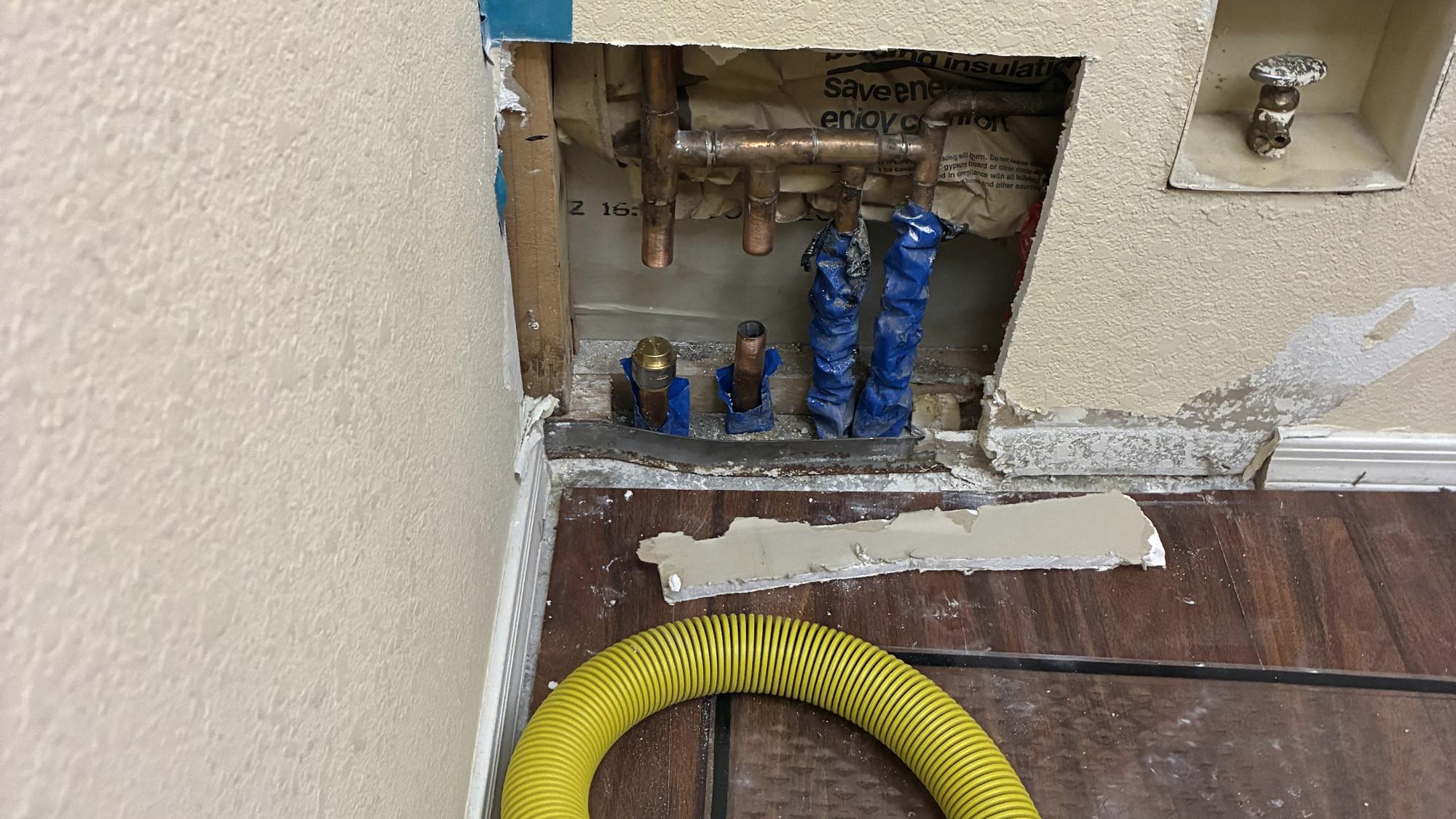
 Drying the cavity after a leak
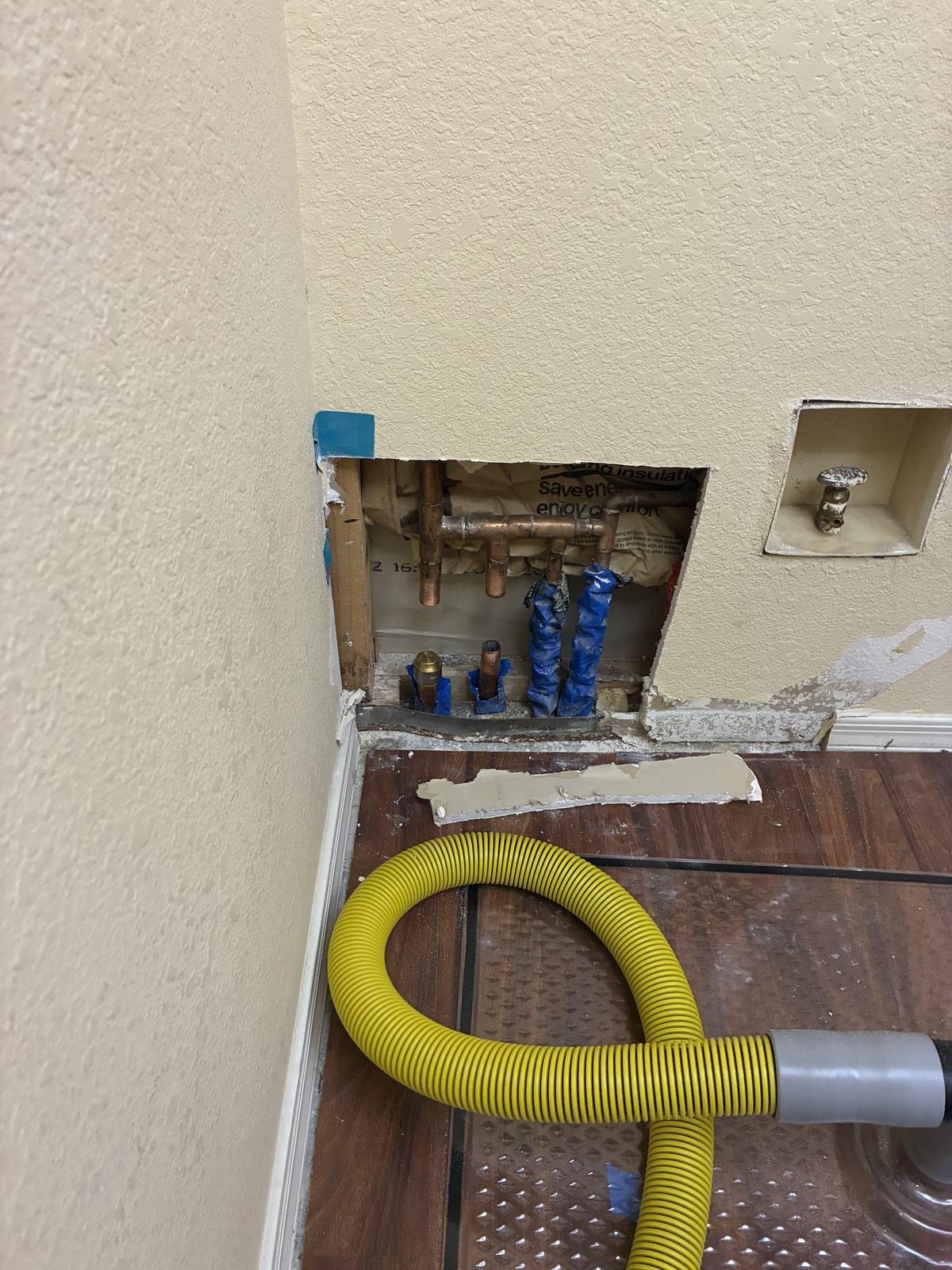
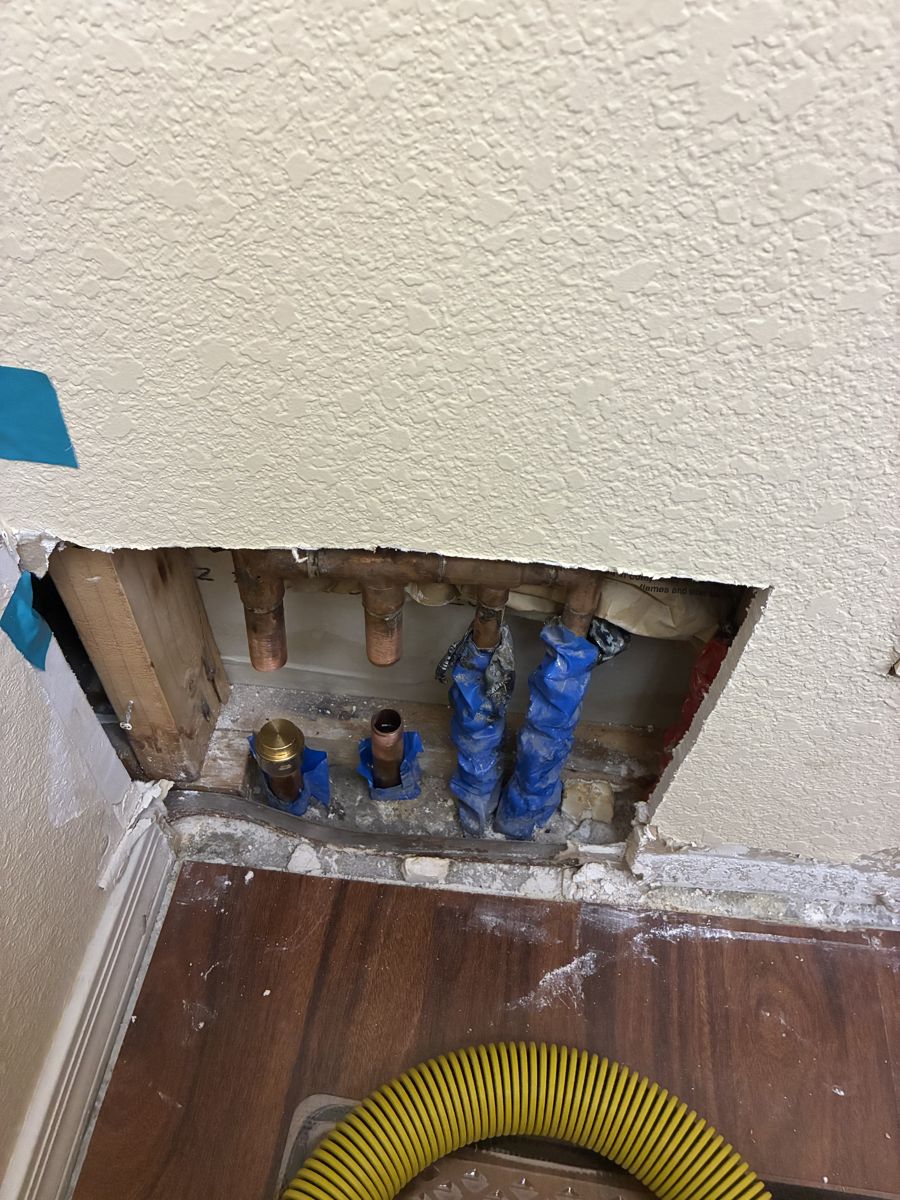 Wall opened, stubs capped, cavity drying
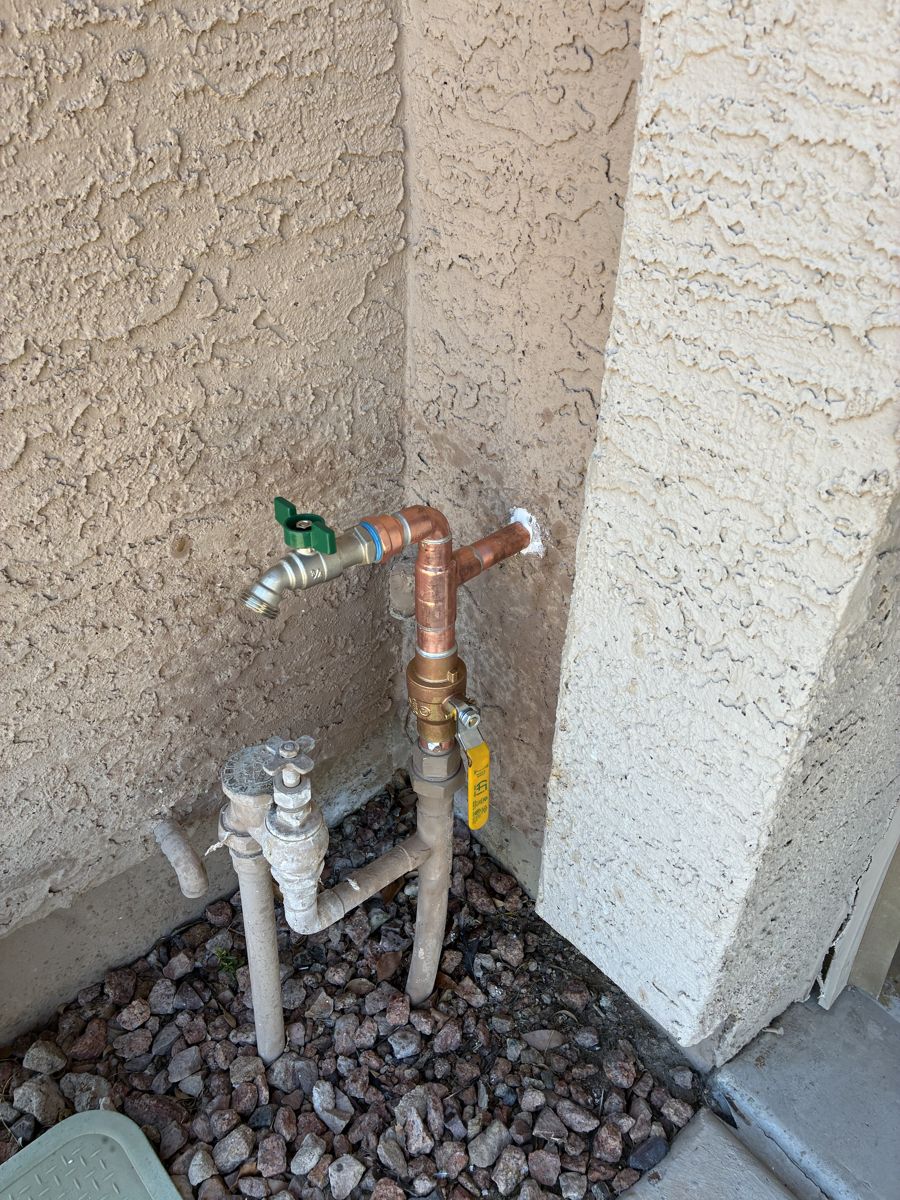 After: new hose bib and ball valve
Where bursts happen
Two stories by era: older stock fails from the inside after decades of scale-forming water, and newer stock fails at exposed exterior fittings that have been cooked by summer and then hit by a January freeze.
Answers, not a brochure.
Where is my water shutoff?
Check three places in order. First, the garage wall near the water heater, where slab-on-grade builders commonly put the interior shutoff. Second, an exterior wall where the service line enters, often near a hose bib. Third, the meter box at the curb, which has a valve on the house side. Find it and turn it once now, while nothing is wrong. A valve untouched for fifteen years often won’t move when you need it.
Do pipes freeze in the East Valley?
Interior pipes essentially never do. What does freeze, on the coldest January nights, is anything exposed outside: hose bibs, irrigation manifolds, backflow assemblies, and pool equipment lines. Those fittings have also spent all summer in direct sun and extreme heat, so the rubber and plastic in them are already degraded when the cold arrives. Insulated hose bib covers cost a few dollars and prevent the most common version of this.
Should I call my insurance company before or after the plumber?
Photograph first, plumber second, insurer third. Stopping the water and documenting the scene are both time-sensitive. The claim isn’t. Most policies also require you to mitigate further damage, which means getting the water shut off and the repair started is the correct move, not a claim risk. Ask us to itemize the invoice so that pipe repair, access, and restoration appear as separate lines, because adjusters treat those three differently.
Can I use a repair clamp and deal with it later?
As a stopgap for a few hours until we get there, a clamp on an accessible line can buy you your water back. As a repair, no. A clamp holds pressure against a hole in pipe that already failed once, and the metal on either side of that hole is the same age and the same thickness. We cut back to sound pipe on both sides rather than leaving a clamp in the wall, and so will anyone else worth calling.
My pipe burst and the pressure was fine before. What changed?
Possibly the pressure-reducing valve at your main, if you have one. A PRV is mechanical and it fails, usually open. Worth being accurate: most East Valley utilities deliver at or below the 80 psi the code sets as the ceiling, so the city isn’t generally running homes over the limit. Put a gauge on a hose bib rather than assuming, and if it reads over 80, fix that first.
Is a burst pipe an emergency if I shut the water off?
It stops being a flooding emergency and becomes a scheduling problem, which is a much better problem. Once the main is off and the pressure is bled, nothing is getting worse except the water already in the structure. Use the time: get the wet material moving air, photograph everything, and book the repair during standard hours instead of paying the after-hours premium that Phoenix-area shops commonly apply.
If water is moving right now, shut the main first and call. The form is slower than a phone.