
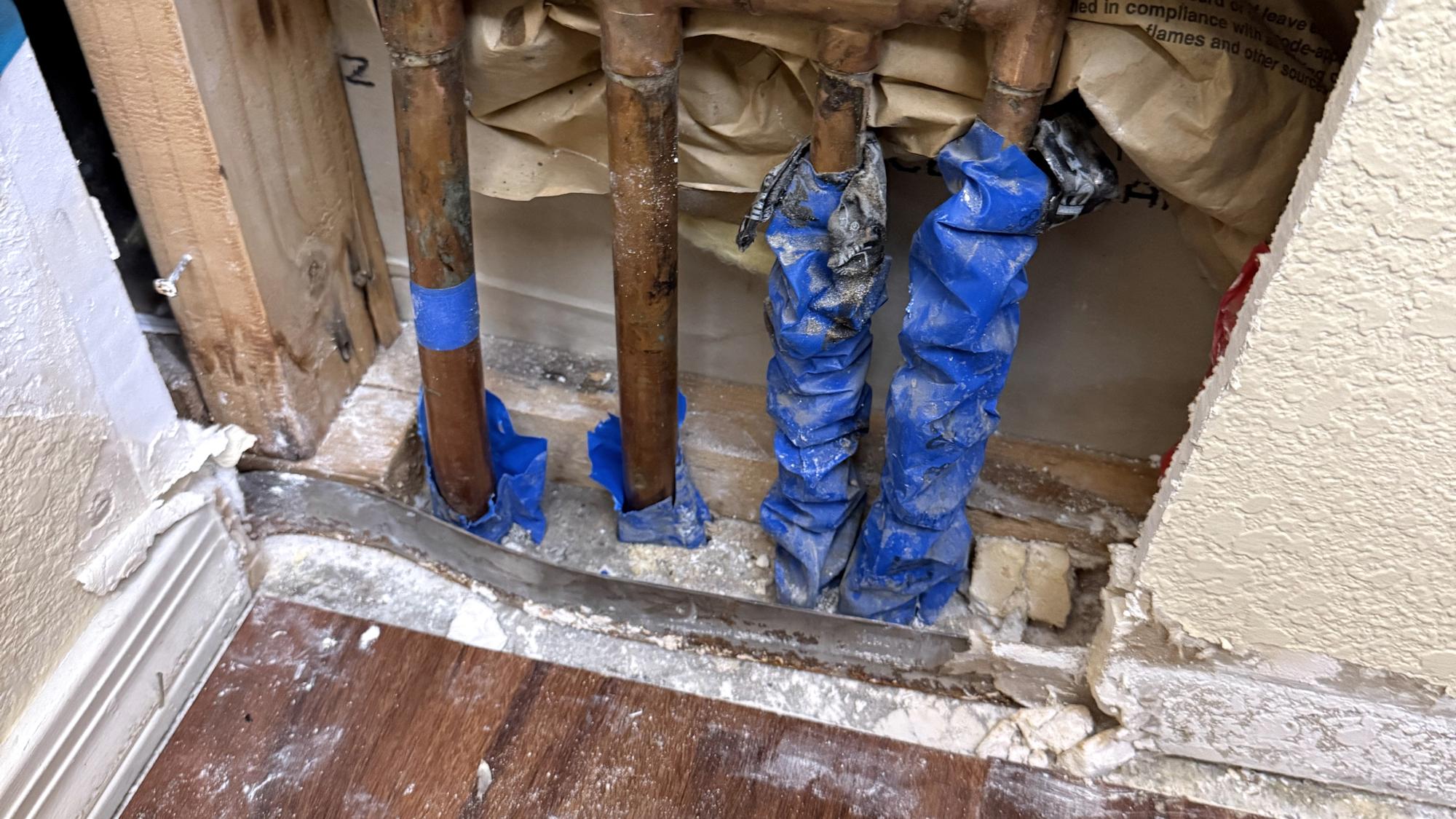
Three leaks in eighteen months isn't bad luck. It's a pattern.
Repiping is what you do when you stop paying detection and access costs on a system that keeps failing. The pipe is the cheap part. Getting to it and closing the walls is the number.
A whole-home repipe replaces every supply line in the house, typically running $5,000 to $15,000 in the East Valley depending on size, pipe material, and access: with drywall patching, texture, and paint frequently invoiced separately. The standard trigger is three or more pinhole leaks in about eighteen months, at which point you’re paying repeated detection and access costs on a system that will keep failing.
Why copper here thins from the inside
Valley water deposits scale rather than eating metal, which sounds like good news for copper and is, up to a point. What scale does is narrow the effective bore of the pipe. Narrower bore at the same demand means higher water velocity, and velocity is what erodes copper from the inside at elbows, tees, and tight turns. That’s the mechanism behind a pinhole: not a chemical attack on the whole system, but decades of accelerated flow wearing thin spots at the places the water has to change direction.
Polybutylene: check rather than worry
Every repipe page in this market runs the polybutylene scare. Polybutylene was manufactured from 1978 to the middle of 1995 (gray, sometimes blue, flexible pipe with crimp fittings) and it earned its reputation honestly. Whether your house could have it is a question about its build year, and that varies enormously across the valley: most of Queen Creek’s housing went up after 2000, most of Scottsdale’s before. So: look. Check the supply stub at your water heater, under a sink, and at the main shutoff. Gray flexible plastic with crimp rings is polybutylene and worth a real conversation. Copper or white or red PEX isn’t, and no honest contractor will tell you otherwise.
PEX or copper, honestly
PEX is flexible, so it can often be pulled through existing wall cavities and the attic with far fewer openings, which is why it’s materially cheaper to install even though the material cost difference is modest. It’s unaffected by the scale chemistry that erodes copper and it has no soldered joints to fail. Copper is rigid, more expensive to install, holds up to heat and UV better in exposed runs, and some homeowners simply prefer it. In this water, PEX is the more defensible choice on the merits, and it’s what most local repipes use. Attic runs are worth a specific question either way, because a valley attic in July is a genuinely punishing environment for any material.
What the quote should separate
Three things: the plumbing, the drywall opening and closing, and the finish work. Repiping means cutting access at every fixture wall, and Phoenix-area cost data commonly shows drywall patch, texture, and paint landing on a separate invoice: sometimes several thousand dollars of it. A quote that doesn’t say which of the three it includes isn’t comparable to one that does. A repipe is permitted, inspected work in every East Valley city; we pull the permit and it’s on the written quote.
Where this page cites a utility, permit or housing figure for a specific town, it’s that town’s published data. Your own city’s water report applies to your tap and your city’s building department sets your permit rules; ask us which apply to your address.
When repiping stops being optional
The industry rule of thumb, and it holds. At that rate you’re funding repeated access costs on a failing system.
Gray or blue flexible pipe with crimp fittings. Uncommon in newer subdivisions, but if you have it the clock is real.
Galvanized supply corroding closed from the inside restricts every fixture at once, gradually enough that nobody notices.
Water sitting overnight in corroding pipe picks up what the pipe is shedding, then clears after a minute of flow.
One leak is a spot. Leaks migrating around the house means the whole system reached the same age at the same time.
A remodel that has drywall down anyway removes the single largest cost of repiping. The timing argument is real.
What a repipe runs in the East Valley
Size, fixture count, story count, and material set the plumbing number. What’s not in most plumbing quotes is the drywall and paint, and that’s where two quotes stop being comparable.
Compiled 2026-08-21 from published Phoenix-metro price guides (plumbingpriceguide.com/phoenix-plumbing-cost, phoenixplumbingauthority.com, desertrainplumbing.com, plumbingphoenixpros.com), which carry a local figure for this job. Those guides put a whole-home repipe at $5,000–$15,000 for a roughly 2,000 square foot single-story Phoenix home, with drywall patch and texture commonly adding $2,800–$6,500 outside the plumber's invoice. Individual pages run lower on small or partial jobs, which is why the floor here’s $5,000 rather than the $4,000 some of them publish. The copper row is the least directly sourced figure on this page. These are metro-wide planning guides, not a quote: only the plumber standing in your house can give you one.
The diagnostic fee comes off the repair. We charge a service call to come out and diagnose the problem. If you approve the work, that fee is credited against it in full. You hear the fee on the phone before anyone drives, and it’s the same number at every location.
How a repipe week runs
We walk the house and lay it out
We plan every fixture, every run, and every access point before a saw comes out. That’s also when we settle the material and any manifold layout.
We cut access and pull the new lines
Openings at fixture walls and in the attic, then new supply run to each fixture. On PEX that’s far fewer and smaller openings than copper needs.
We tie in, pressure-test, and get it inspected
We connect the new system at the main, pressurize it, and hold it. Every East Valley city inspects plumbing work, and we pull whatever yours requires.
We close up, patch, and finish
Drywall goes back, texture gets matched, paint follows. Settle before we start whether that’s our crew or your own arrangement.
What this job looks like when we do it.
Not stock, not a rendering, and nothing generated. Every photograph on this site is an actual plumbing job in an actual house.
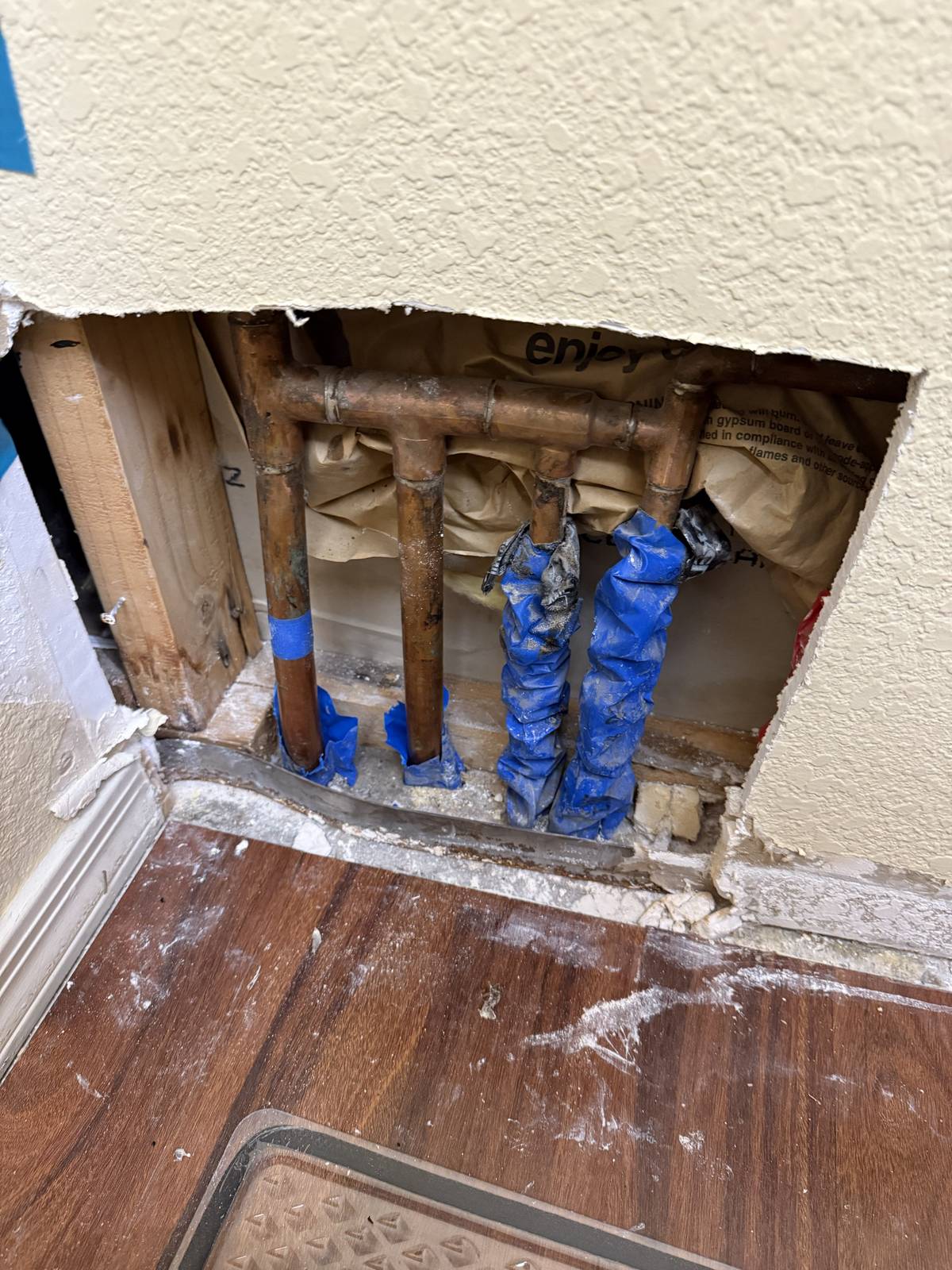 Copper manifold, wall opened for a repipe
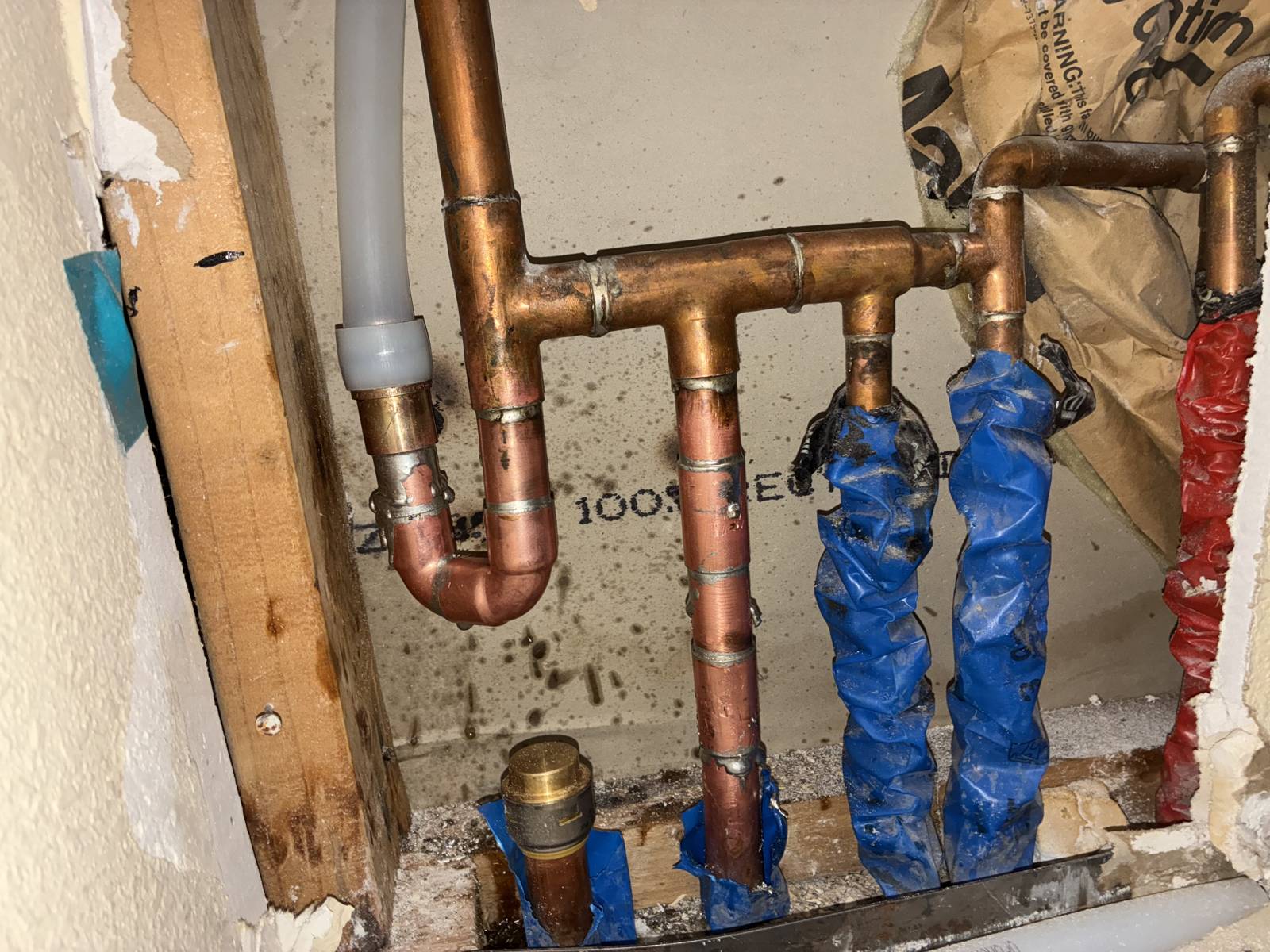 Manifold and PEX tie-in
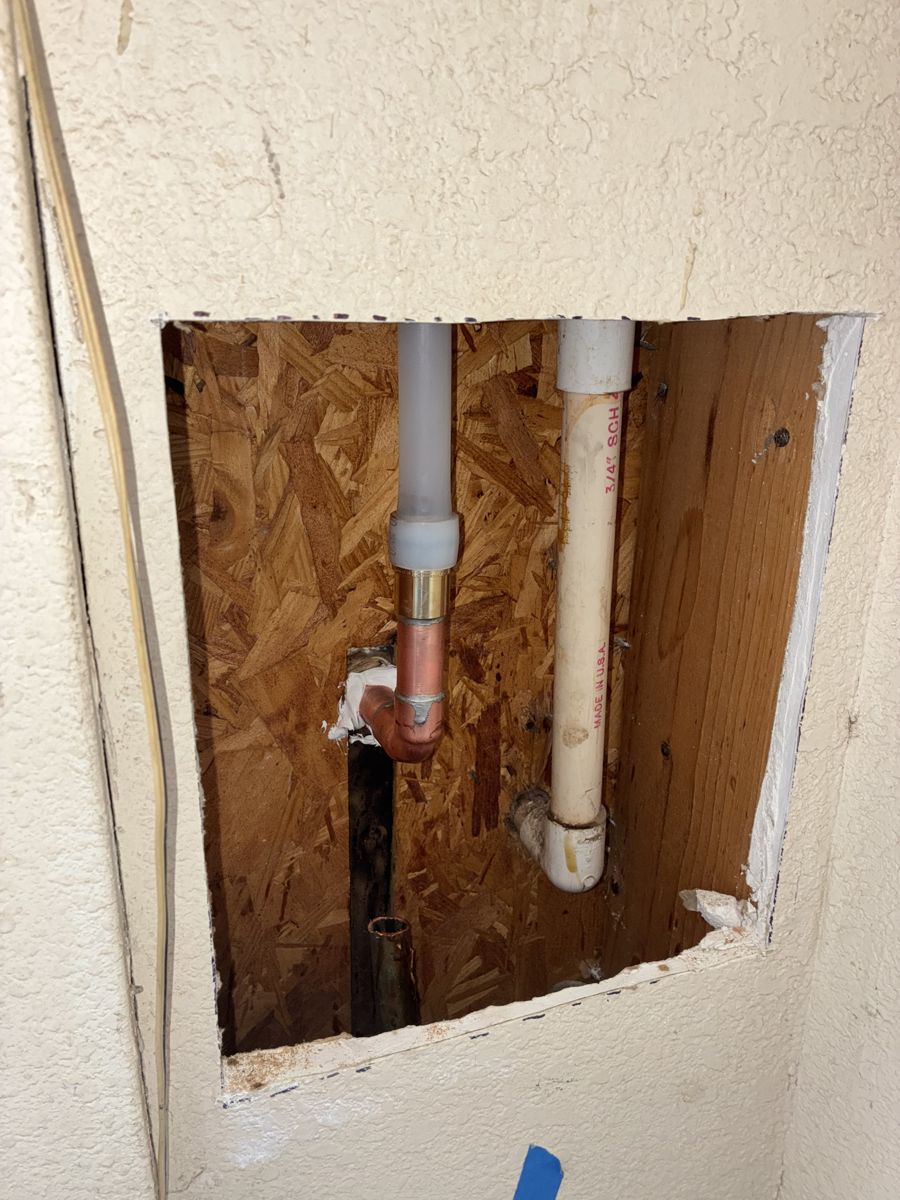 PEX to copper transition
Repipe territory
Repiping tracks build era. Most candidates are in the older parts of the valley, where copper has had the most decades of scale-narrowed bore behind it.
Answers, not a brochure.
How many leaks before I should repipe instead of repairing?
Three or more in roughly eighteen months is the widely used threshold, and the logic is economic rather than arbitrary. Each individual repair carries detection, access, and drywall costs that don’t shrink just because the repair is small. Once leaks are recurring, you’re funding those costs repeatedly on a system that has reached the end of its service life uniformly. Ask us what the pipe looked like where we cut it: visibly thinned wall at the failure point is the tell.
Is PEX or copper better here?
PEX is the more defensible choice here on the merits. Scale-forming water narrows pipe bore over decades, and the resulting higher water velocity is what erodes copper at elbows and produces pinholes. PEX is unaffected by that mechanism, has no soldered joints, and is flexible enough to pull through existing cavities with far fewer wall openings, which is most of why it installs cheaper. Copper handles heat and UV better in exposed runs and some homeowners simply prefer it.
Does a repipe include fixing the drywall?
Frequently not, and this is the single biggest source of two quotes that look different but aren’t. Repiping means cutting access at every fixture wall, and Phoenix-area cost data commonly shows drywall patch, texture matching, and paint arriving on a separate invoice that can run into the thousands. Ask each contractor explicitly whether their number includes closing the walls, matching texture, and painting, and get the answer in writing.
How do I know if my house has polybutylene pipe?
Look for gray, occasionally blue, flexible plastic supply pipe with crimped fittings. The easiest places to check are the stub-out at the water heater, under a sink, and at the main shutoff. Polybutylene was made from 1978 to mid-1995, so the odds depend on when your part of the valley was built: unlikely in Queen Creek, worth checking in older Scottsdale and Ahwatukee stock. Identify the material rather than assuming either way.
How long does a whole-home repipe take?
Typically two to five days for the plumbing on a standard single-story home, longer for two stories or copper. You generally keep water overnight for most of it, though expect at least one day with the water off for the tie-in. The drywall, texture, and paint that follow are their own schedule and often add another several days, which is worth knowing before you plan around the plumbing dates alone.
Will repiping fix my water pressure?
If corroded or scale-narrowed supply pipe is what’s restricting flow, dramatically. Galvanized pipe that has closed down from the inside is a genuine house-wide restriction and replacing it transforms the pressure. But so does a failed pressure-reducing valve, a partly closed main shutoff, or a clogged whole-house filter, and all three are vastly cheaper. Have static pressure read at a hose bib with a gauge before anyone quotes a repipe on a pressure complaint.
Often the same visit.
Tell us how many leaks, over how long, and in which rooms. That's the whole decision.