
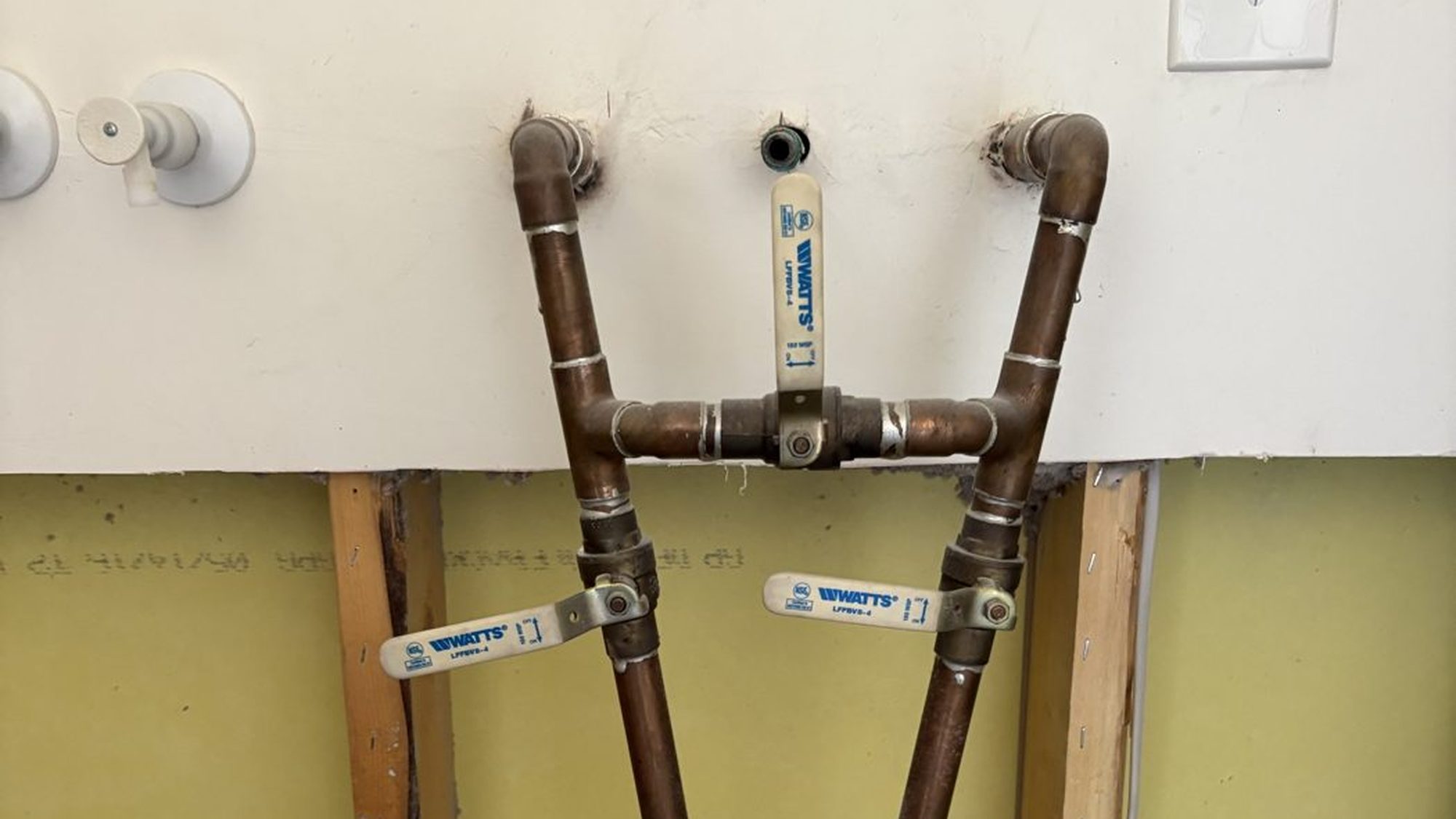
The pipe between the meter and your house is yours.
The city owns the main and the meter. Everything from the meter to your wall is the homeowner's, which is why no city crew is coming to dig up that green stripe in the yard.
The water service line runs from your meter at the curb to the point it enters your house, and across the East Valley that segment is the homeowner’s responsibility, not the city’s. Replacing it typically runs $3,000 to $12,000, with excavation and surface restoration (driveway, sidewalk, hardscape, mature landscaping) driving nearly all of the spread rather than the pipe itself.
Why the failure is on your side
The city owns the main and the meter. Everything from the meter to your wall is yours, and East Valley utilities keep their side in good shape. So when a homeowner finds a wet stripe of yard between the curb and the house, the failure is almost always in the service line, which the homeowner owns. That single boundary is the most expensive thing to misunderstand about this job.
The lead question, answered plainly
This gets used to sell things. East Valley utilities have completed their lead service line inventories and report no known lead lines in residential service; if someone tells you your line needs replacing because of lead, ask them what they’re basing it on. Replace a service line because it leaks, because it’s undersized, or because it has failed repeatedly. Not because of a scare.
What actually kills a service line here
Age, mostly, and ground movement. Valley soils can be expansive or compressive parcel by parcel, and the Arizona Department of Water Resources maps a land subsidence feature covering much of the East Valley, though nobody can attribute a particular broken pipe to it. Beyond ground movement: older galvanized service lines corrode closed from the inside and present as a house-wide pressure complaint long before they leak, and copper lines fail at joints and where they enter the foundation.
Caliche is a digging cost, not a pipe problem
Caliche is a cemented calcium carbonate layer common in southern Arizona soils (University of Arizona Cooperative Extension, publication az1281). It doesn’t break your pipe. What it does is make excavation expensive, because it doesn’t yield to a shovel or a small trencher and needs hydraulic breakers or rock attachments. Phoenix-area figures put a comparable spot repair at roughly double through caliche. Ask us whether we have hit caliche on your street before, and ask anyone else quoting excavation the same thing.
Trenched versus trenchless, and what it costs you above ground
Open trenching is the straightforward method: dig meter to house, lay new pipe, backfill. Cheaper per foot, and it destroys whatever sits on top of the trench. Trenchless pulls new pipe through with pits at each end, costs more, and preserves a driveway or an established front yard that would cost thousands to put back. Which is right is a site question. Get surface restoration quoted as its own line either way. A service line replacement needs a permit in every East Valley city; we pull it and it’s on the written quote.
Where this page cites a utility, permit or housing figure for a specific town, it’s that town’s published data. Your own city’s water report applies to your tap and your city’s building department sets your permit rules; ask us which apply to your address.
How a failing service line announces itself
One line of grass or weeds thriving where nothing else is. That’s your service line, watering itself.
A restricted or corroded service line starves the whole house, unlike a fixture problem that affects one tap.
If the interior main is closed and the meter still turns, the loss is between the meter and that valve.
Water escaping underground carries fines with it, and the surface settles above the void.
Corroding galvanized pipe sheds into the water sitting in it overnight, then clears after a minute of flow.
What water line work runs in the East Valley
Two very different jobs share this page. A spot repair on one small exterior leak is a few hundred dollars and sits below the headline range. A full meter-to-house replacement is priced by the foot, by the soil, and by what’s sitting on top of it.
Planning range, flagged honestly: the published Phoenix-metro sources checked on 2026-08-21 (plumbingpriceguide.com/phoenix-plumbing-cost, phoenixplumbingauthority.com, desertrainplumbing.com, plumbingphoenixpros.com) didn’t carry a specific local figure for this job, so this range is built from local labor rates plus the components involved. What I could source directly: Angi's Phoenix water main repair page (checked 2026-08-21) puts a repair at $332–$894 normal range, $150 to $1,900 at the extremes, roughly $100–$200 per linear foot, with a Phoenix permit averaging $150. Full meter-to-house replacement, and trenchless in particular, is where the published local figures run out. Treat it as a sanity check rather than a benchmark, and not as a quote.
The diagnostic fee comes off the repair. We charge a service call to come out and diagnose the problem. If you approve the work, that fee is credited against it in full. You hear the fee on the phone before anyone drives, and it’s the same number at every location.
How we run a replacement
We locate it and confirm it
We verify the leak is in the service line and not inside the house, then locate the existing run so we can plan the new one around your hardscape.
We call Blue Stake before we dig
We call Arizona 811 before a shovel moves. Gas, power, and communications all share that front yard, and Southwest Gas emergency is (877) 860-6020 if anything is ever struck.
We lay the pipe and test it
New line laid or pulled, connections made at the meter and at the house, then we pressurize it and hold it before anything gets buried.
We backfill, compact, and restore
We backfill the trench in lifts and compact it so your yard doesn’t sink in six months. Confirm in writing who is restoring the surface.
What this job looks like when we do it.
Not stock, not a rendering, and nothing generated. Every photograph on this site is an actual plumbing job in an actual house.
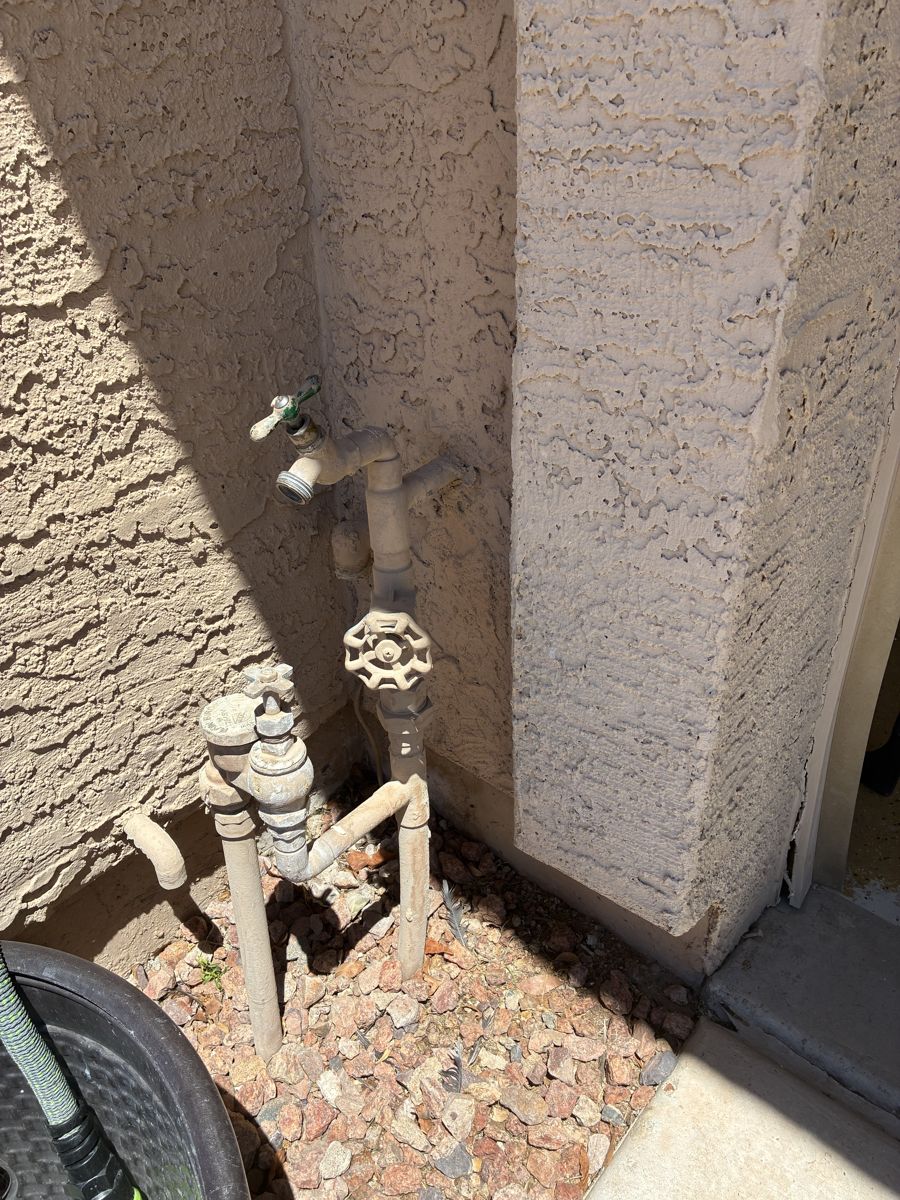 Before: the old hose bib and regulator
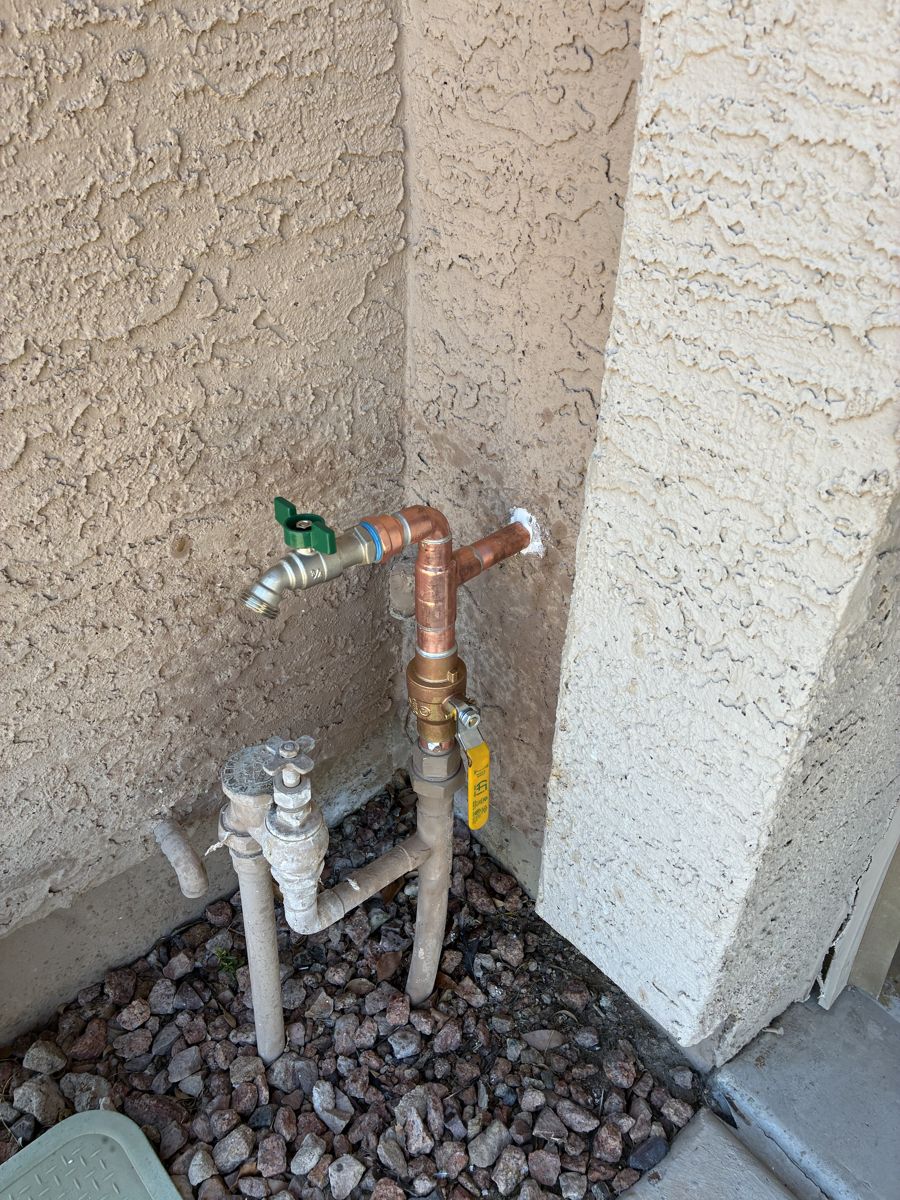 After: new hose bib and ball valve
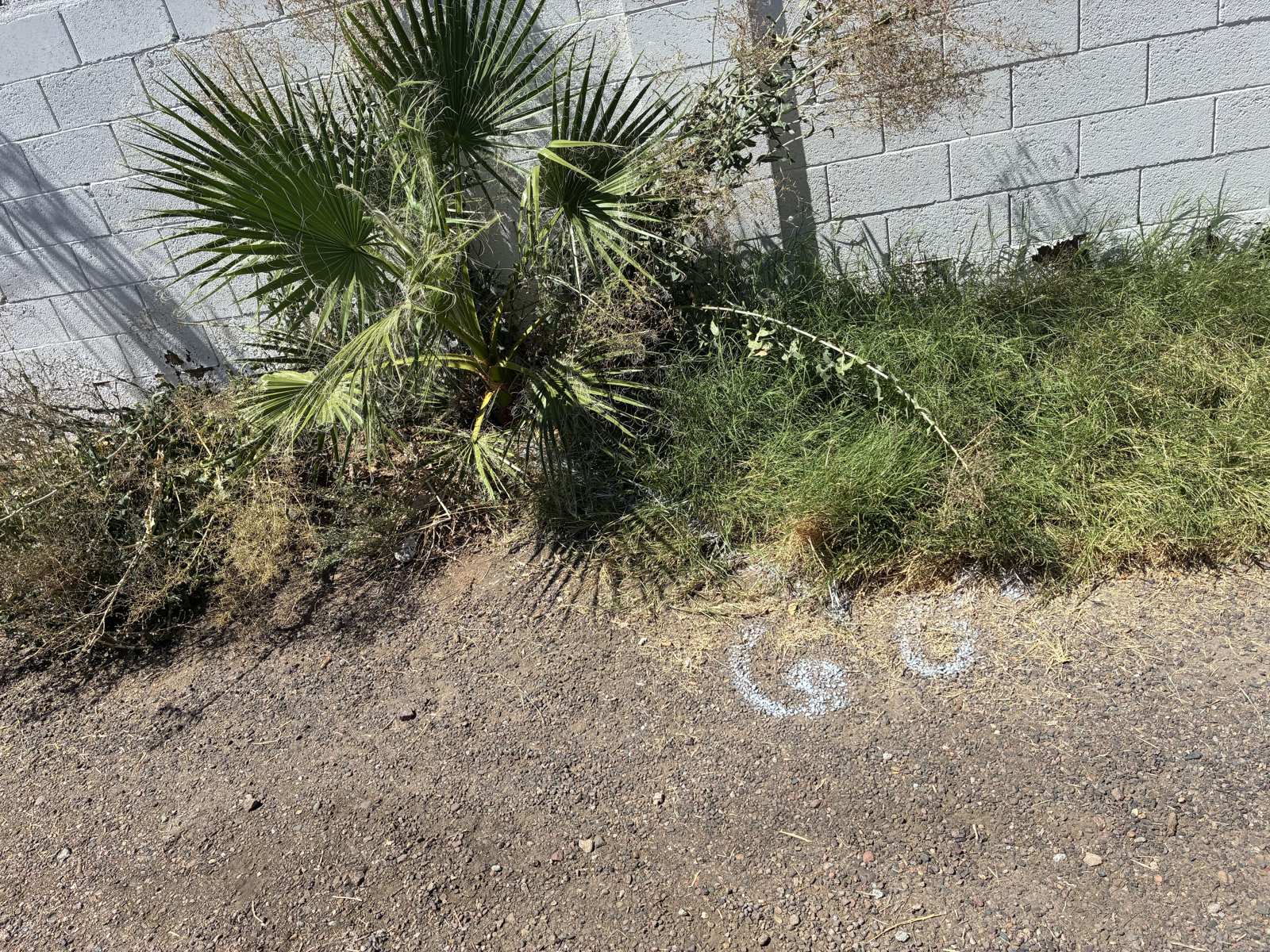 Locate marks: where the line runs and how deep
Service lines by vintage
Service line material tracks build era more tightly than almost anything else in a house. The oldest neighborhoods carry the oldest pipe, and the oldest pipe is where the repeat leaks start.
Answers, not a brochure.
Who is responsible for the water line between the meter and my house?
You are. The city owns the distribution main and the meter. Everything on the house side of that meter is private property and private responsibility. That’s why a leak in your front yard doesn’t get a municipal repair crew. Your water utility can confirm the boundary for your specific address and pull your usage history, which is useful documentation if you’re trying to work out how long the line has been leaking.
Are there lead service lines in the East Valley?
East Valley utilities have completed the federally required lead service line inventories and report no known lead lines in residential service. Replace a service line because it leaks or has failed repeatedly, not because someone raised lead. If a contractor leads with lead, ask what they’re basing it on.
Is trenchless worth the extra money?
It depends entirely on what’s sitting on top of the trench. If the run crosses plain dirt or turf, open trenching is cheaper and the yard recovers. If it crosses a paver driveway, a stamped concrete walkway, or twenty years of established desert landscaping, the restoration cost of digging through it can exceed the price difference on its own. Ask both contractors to quote the surface restoration as a separate line so you’re comparing the same total.
How long does a water service line last?
Longer than most homeowners fear. Phoenix-area data puts water main life at 50 to 100 years. What shortens it locally is soil movement through wet and dry cycles working buried joints, and corrosion in older galvanized lines, which restricts flow long before it leaks. Repeated repairs on the same run is the real signal to replace rather than any particular age.
Can I replace the service line myself?
Practically, no. The connection at the meter is the city’s equipment, the excavation crosses buried gas and electric that require Arizona 811 notification before any digging, and the work is inspected. Arizona also requires licensed contractors for plumbing work of this scope, and the ROC recovery fund doesn’t cover work done by unlicensed individuals. This is one of the clearer cases where the permit and the license are doing something for you.
Will replacing the line fix my low water pressure?
Only if the line is what’s restricting it. A corroded galvanized service line genuinely does choke a whole house, and replacing it transforms the pressure. But so does a failed pressure-reducing valve, a partially closed main shutoff, or a clogged whole-house filter, and all three are much cheaper to fix. Ask us to put a gauge on a hose bib and read static pressure before anyone quotes a replacement.
Tell us where the wet stripe runs and whether the house pressure dropped. That splits the diagnosis in half.